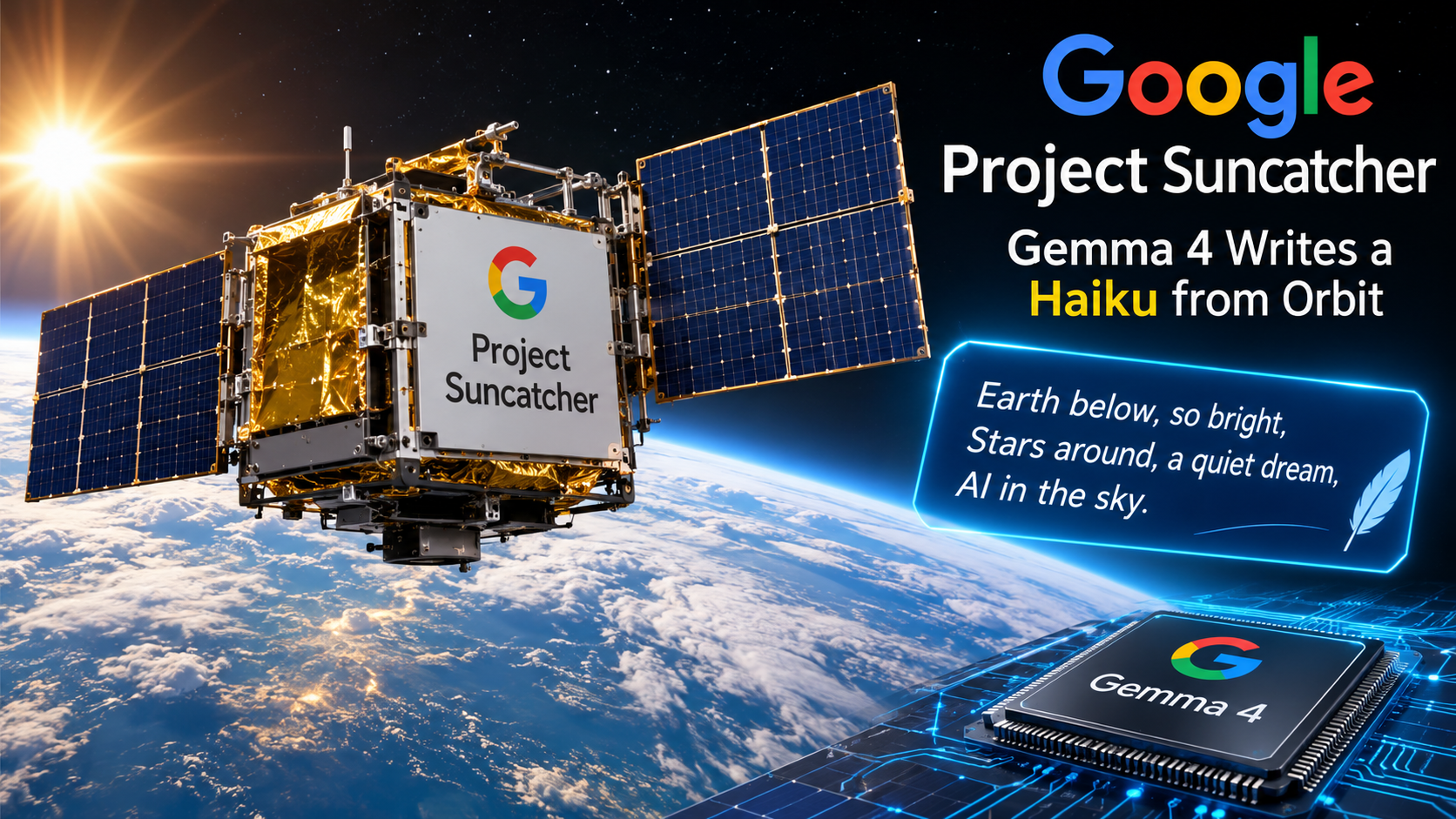
Google has received the first AI response from a data-center-class Tensor Processing Unit (TPU) operating in orbit. The reply came from Google DeepMind’s open Gemma 4 model, running on the Google Project Suncatcher prototype satellite. Google announced the milestone on October 30, 2026.
What Happened With Google Project Suncatcher?
The prototype launched on October 1, 2026, aboard a SpaceX rocket on the Transporter-18 rideshare mission. Google built the refrigerator-sized satellite with Planet. It carries four Trillium TPUs, and reports put its solar power at about 1 kW.
After a few weeks of commissioning, the team powered up the host computer and the TPU trays and ran early machine learning tests. Then came the “Hello World” moment. During a ground-station pass, engineers uplinked a prompt asking Gemma 4 to write a haiku about being in space. The reply came down as the satellite passed over Svalbard, Norway. You can read the full haiku in Google’s official blog post.
The team then tested space-themed limericks and prompts asking the satellite to report its technical status. Google said the satellite is operating as expected.
Is This Really the First AI in Space?
Not quite, and the wording matters. Google’s claim is the first AI response from a data-center-class TPU in orbit. It is not the first AI model to run in space. In November 2025, the startup Starcloud ran a version of Gemma on an Nvidia H100 GPU aboard its Starcloud-1 satellite.
Why AI in Space Matters
Modern AI models need huge amounts of power, and ground data centers face growing pressure over energy use, cooling and local impact. In orbit, solar panels can collect far more sunlight than on the ground. Travis Beals, who leads the project, has said a panel in the right orbit can generate five to eight times more power than one on Earth.
Space is not automatically cooler, though. With no air, heat can only leave by radiation, which makes thermal management one of the hardest problems. The prototype reportedly runs each TPU for about 15 minutes at a time before shutting it down to cool.
What Is Google Project Suncatcher?
Project Suncatcher is a Google research moonshot. It asks whether solar-powered satellites carrying TPUs could one day work together as scalable AI infrastructure. The current satellite is deliberately minimal. Its job is to show that Google’s AI chips can survive launch, power up and run real inference in the space environment.
What’s Next for Project Suncatcher?
The next phase will test how the TPUs handle thermal stress and radiation. That data will decide whether the chips are reliable over the long term.
In 2027, Google plans to launch two more satellites with Planet. They will test high-bandwidth laser links between spacecraft, to see whether several satellites can work as one distributed computing cluster. Google has described space-based AI compute as a long-term bet, with cost parity depending on much cheaper launches in the mid-2030s.
Final Thoughts on Google Project Suncatcher
A short haiku does not make an orbital data center. But the Google Project Suncatcher result shows that a data-center-class TPU can run AI inference in space, and that is the first step toward Google’s longer-term plan.