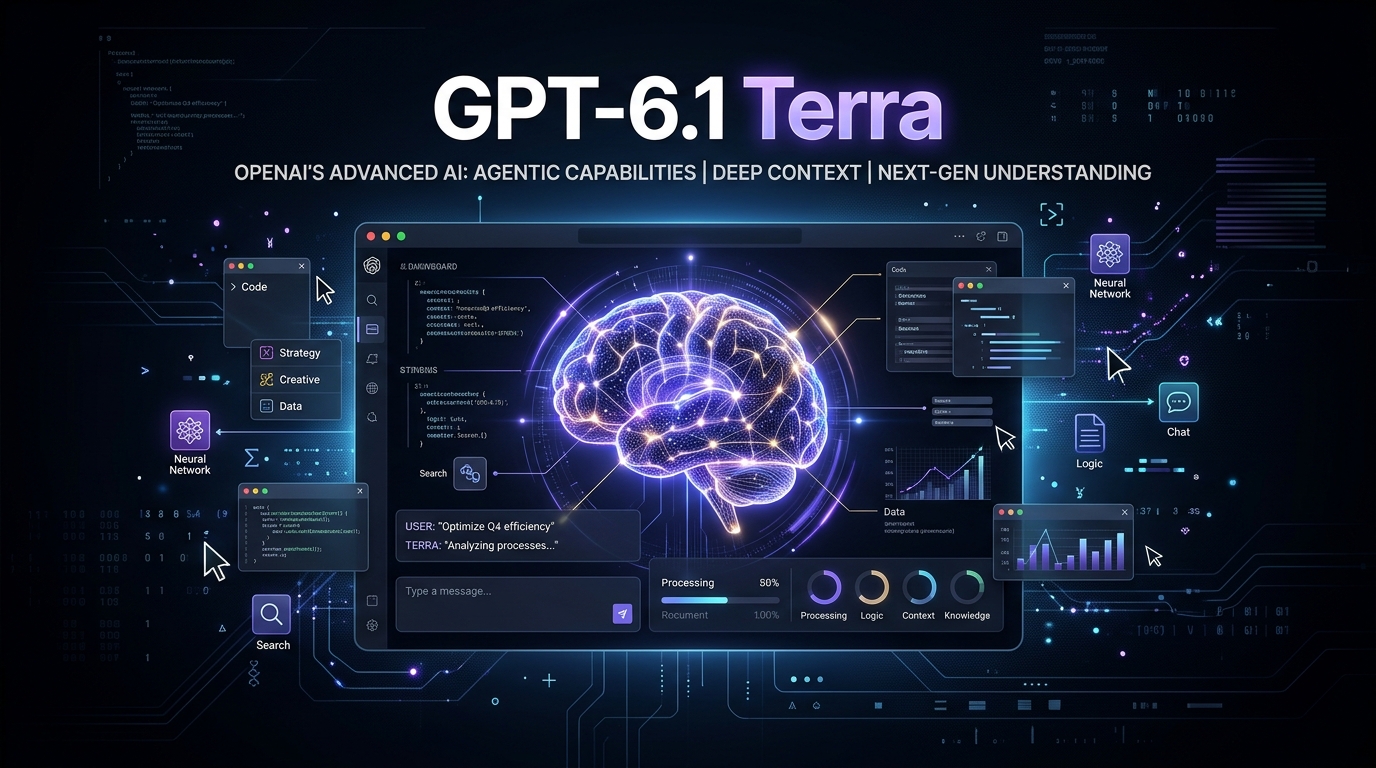
OpenAI has launched GPT-6.1 Terra, a mid-tier model built for computer use, visual reasoning and everyday office work. It arrived on October 26, 2026, and costs far less than its predecessor. On the same day, OpenAI announced three separate scientific claims in mathematics, computer science and physics. Those claims are unrelated to Terra and remain under expert review.
What Is GPT-6.1 Terra?
GPT-6.1 Terra is the mid-range model in OpenAI's current lineup. It can read what is on a screen, click, type, and move between applications to finish multi-step tasks. OpenAI describes it as a major step up from GPT-5.6 Terra for tasks like drafting proposals, interpreting technical drawings, filling out forms and editing videos.
GPT-6.1 Terra Pricing and Specifications
The API model ID is gpt-6.1-terra. Key details:
- Price: $1 per million input tokens and $5 per million output tokens
- Predecessor price: GPT-5.6 Terra was reported at $2 / $12
- Context window: about 1.05 million tokens
- Max output: 128K tokens
- Knowledge cutoff: June 1, 2026
- Supports: computer use, function calling, web search, file search, MCP and skills
GPT-6.1 Terra Benchmarks and Performance
OpenAI says that on Agents' Last Exam, a professional computer-use benchmark, Terra at medium reasoning effort scores 15 percentage points above GPT-5.6 Terra at about one-third of the cost.
On Terminal-Bench 4.0, which tests coding agents through the command line, Terra at maximum effort solved 50.3% of tasks versus 21.5% for its predecessor. OpenAI also reports that factual errors at low reasoning effort fell from 53.6% to 16.7% in its internal test. These are OpenAI's own numbers, so independent testing is still worth waiting for.
Where to Use GPT-6.1 Terra
Terra is available to Plus, Pro, Enterprise and Edu users in ChatGPT Work and Codex. Developers can access it through the API. OpenAI says the same plan allowance now covers more tasks than with GPT-5.6 Terra.
GPT-6.1 Terra vs GPT-6.1 Sol and GPT-6 Astra
Terra is not OpenAI's strongest model. OpenAI points developers to GPT-6 Astra for complex reasoning and coding, and to GPT-6.1 Sol for a balance of intelligence and cost. Terra suits high-volume, screen-based work where speed and cost per task matter most.
OpenAI's Separate Science Claims: Kakeya, ETH and QCD
Alongside the launch, OpenAI published a post titled "Working with academic communities to build scientific understanding." It claims its internal models:
- Proved the local smoothing conjecture in every dimension, which would also resolve the Kakeya and Stein restriction conjectures
- Refuted the Exponential Time Hypothesis, a computational hardness assumption used in many complexity papers for nearly 30 years
- Produced an existence proof for four-dimensional quantum field theories, including QCD and pure Yang-Mills theory
OpenAI has published Lean formalizations for the math and ETH results. The ETH review is led by Russell Impagliazzo, Ramamohan Paturi and Ryan Williams, and the physics result is being reviewed by a group led by David Gross. No peer-reviewed paper exists yet, so these remain claims until the community confirms them.
Why GPT-6.1 Terra Matters for AI Agents
For businesses, the main barrier to deploying AI agents is often cost per task rather than raw capability. A cheaper, faster computer-use model makes automation of repetitive desktop work more realistic. The same capability also carries risk, since a model that can operate software cheaply is useful to bad actors too, so safety testing deserves attention.
Conclusion
GPT-6.1 Terra is a practical release: cheaper, faster and stronger at computer use than GPT-5.6 Terra. OpenAI's science claims are a separate story and need verification before anyone treats them as settled.