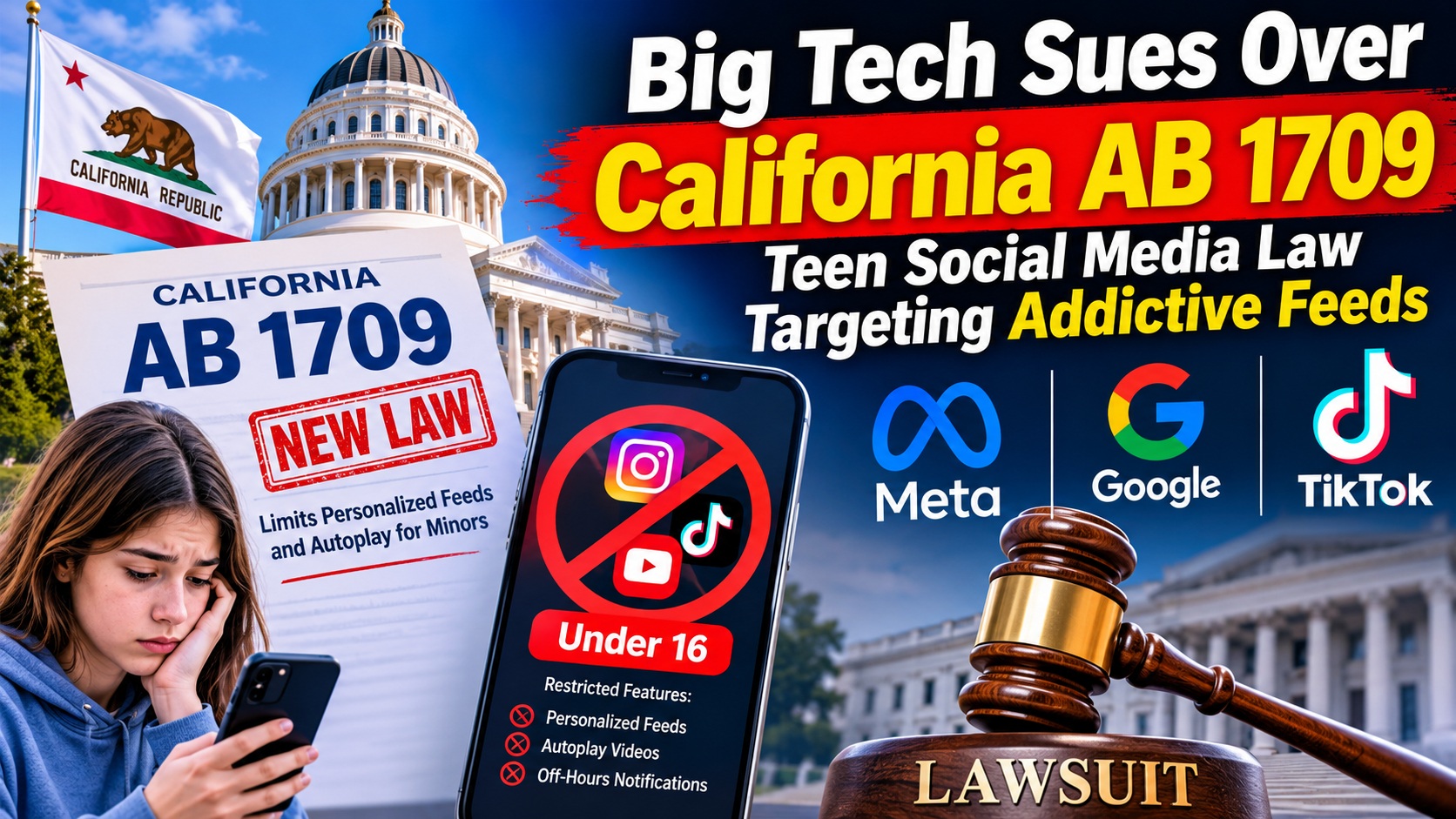
Meta, Google and TikTok have taken California to federal court over a new law that limits what social media platforms can offer users under 16. The three companies filed separate lawsuits on Wednesday, November 4, 2026, naming California Attorney General Rob Bonta as the defendant. The California AB 1709 lawsuit asks courts to block a law that restricts personalized feeds and autoplay for minors before it takes effect on January 1, 2027.
What Is California AB 1709?
Assembly Bill 1709 (AB 1709) was authored by Assemblymember Josh Lowenthal and sponsored by Common Sense Media. Governor Gavin Newsom signed it on September 10, 2026.
The law bars covered platforms from offering under-16 users “psychologically exploitative” or “addictive” features that can lead to compulsive use. These include:
- Personalized or algorithmic content recommendations
- Autoplay videos
- Off-hours notifications
To identify minors, the law relies on a separate California statute, the Digital Age Assurance Act (AB 1043), which also takes effect on January 1, 2027.
How Much Are the Penalties Under AB 1709?
The Attorney General or a local public prosecutor can bring civil actions. Penalties are calculated per affected minor:
- Up to $25,000 per minor for a negligent violation
- Up to $50,000 per minor for a knowing violation
The law does not give private individuals the right to sue.
What Are Meta, Google and TikTok Arguing in the AB 1709 Lawsuit?
All three companies make two core arguments:
- First Amendment: How content is curated and displayed is a protected editorial decision, and the state cannot override it.
- Section 230: The federal law protects platforms from liability for third-party content, and the companies say AB 1709 conflicts with it.
Meta says it currently uses personalized recommendations and autoplay, so the law would force it either to change those practices or to stop providing content to minors altogether. Meta argues this could effectively require it to delete minors’ accounts.
A TikTok spokesperson called the law a “blatantly unconstitutional restriction on free expression.” TikTok also argues that AB 1709 effectively overrides an earlier California law, SB 976, because it bars these features even when parents consent.
Google argues that the law substitutes the state’s judgment for that of parents. The company says YouTube autoplay is already off by default for minors and that parents can block Shorts.
Where Are the AB 1709 Lawsuits Filed?
- Meta: federal court in San Francisco (Northern District of California)
- Google: federal court in San Jose (Northern District of California)
- TikTok: federal court in Los Angeles (Central District of California)
Each company is seeking an injunction that would stop the state from enforcing the law against it.
California’s Position and Child Safety Advocates
Supporters say engagement-driven design can encourage compulsive use and contribute to anxiety and sleep problems in young people. Attorney General Bonta has signaled that the state will defend the law. California has previously passed kids’ online safety legislation, including SB 976, which tech companies have also challenged in court.
What Could Happen Next?
If the courts uphold AB 1709, other states may adopt similar rules. If the companies win, it could become harder for governments to regulate how social media products are designed. It is not yet clear whether a ruling will come before the law’s January 1, 2027 effective date.
What Should Parents Do in the Meantime?
Until the courts rule, parents can monitor their children’s screen time, review privacy settings and use the parental controls that platforms already offer.
This is a developing story and will be updated as the courts rule.