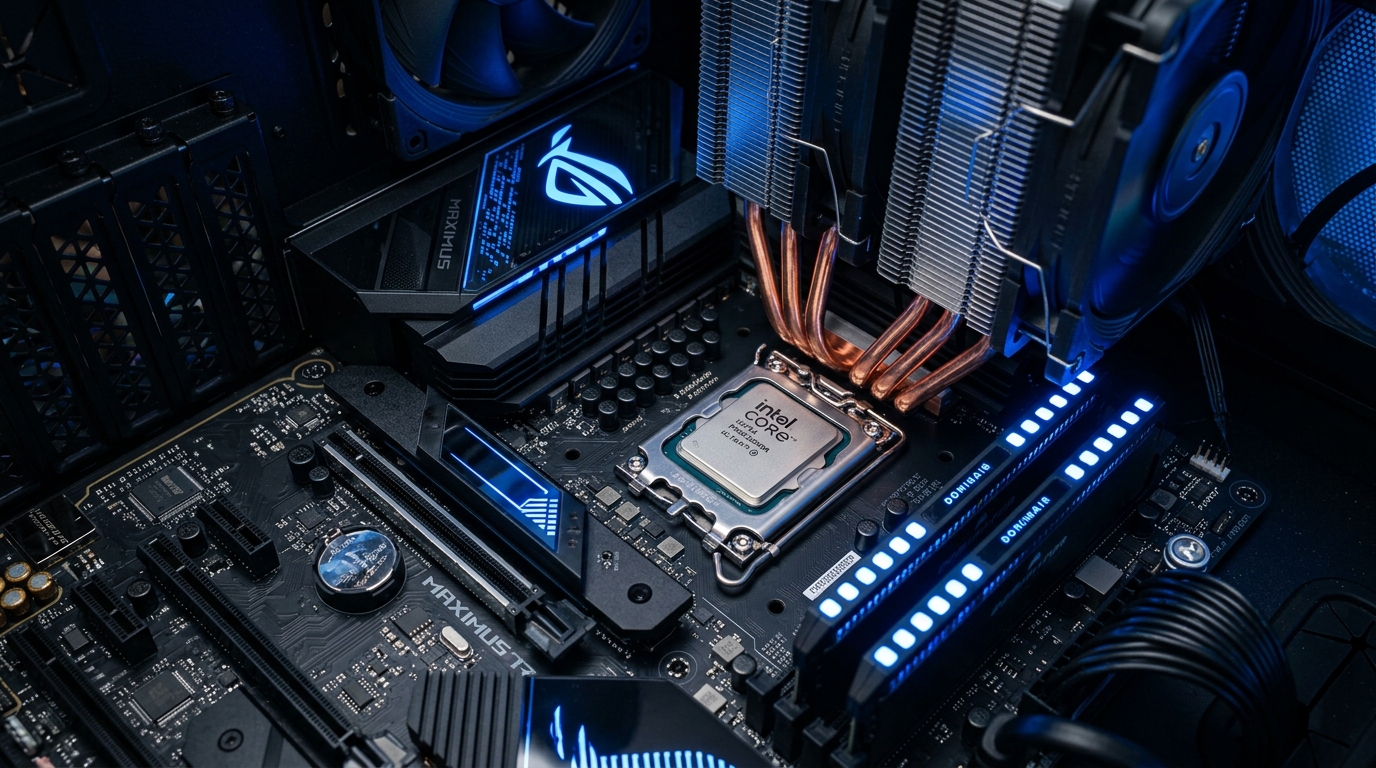
Intel officially unveiled its Core Ultra 200S desktop processor lineup on October 10, 2026, marking the arrival of the Arrow Lake-S architectural generation. The new series shifts the focus from raw peak clock frequencies to dramatic reductions in power consumption and thermal output. Featuring the flagship Core Ultra 9 285K, the family introduces the LGA 1851 socket, detached hyper-threading, and dedicated NPU hardware for desktop PCs.
Arrow Lake Architecture and Power Efficiency
For the past three desktop generations, Intel pushed power limits higher to stay competitive in gaming benchmarks. Arrow Lake reverses that trajectory. Built using a disaggregated tile architecture manufactured on external foundry nodes, the Core Ultra 200S processors achieve up to 40 percent lower package power during gaming workloads compared to previous 14th Gen chips.
The architecture pairs new Lion Cove Performance cores (P-cores) with Skymont Efficient cores (E-cores). Notably, Intel eliminated hyper-threading on the P-cores. Company testing indicates that dedicating silicon area to wider execution pipelines and larger instruction windows yields higher single-thread throughput without the thermal penalty of simultaneous multi-threading. Combined with hardware advances seen in mobile devices like the Apple HomeView smart display, modern silicon design increasingly prioritizes sustained thermal efficiency over raw peak bursts.
Core Ultra 200S Specifications and Lineup
Intel introduced five unlocked processor models spanning the Core Ultra 9, Core Ultra 7, and Core Ultra 5 tiers:
| Model | Cores (P+E) | Max Turbo Clock | Base / Max Power | MSRP |
|---|---|---|---|---|
| Core Ultra 9 285K | 24 (8P + 16E) | 5.7 GHz | 125W / 250W | $589 |
| Core Ultra 7 265K | 20 (8P + 12E) | 5.5 GHz | 125W / 250W | $394 |
| Core Ultra 7 265KF | 20 (8P + 12E) | 5.5 GHz | 125W / 250W | $379 |
| Core Ultra 5 245K | 14 (6P + 8E) | 5.2 GHz | 125W / 159W | $309 |
| Core Ultra 5 245KF | 14 (6P + 8E) | 5.2 GHz | 125W / 159W | $294 |
Each processor includes a built-in Neural Processing Unit (NPU) capable of 13 TOPS. While below the Copilot+ PC threshold of 40 TOPS, this integrated accelerator handles background audio processing, video framing, and creator tasks without waking the discrete GPU.
LGA 1851 Socket and 800-Series Motherboards
Upgrading to Arrow Lake requires a motherboard replacement. The processors utilize the new LGA 1851 socket alongside Intel 800-series chipsets, spearheaded by the Z890 platform. The new socket delivers native PCIe 5.0 lanes directly from the CPU for both graphics cards and high-speed NVMe storage simultaneously, resolving previous bandwidth sharing limitations.
Support for DDR4 memory is entirely phased out. The platform exclusively supports dual-channel DDR5 memory, featuring official support for speeds up to DDR5-6400 out of the box and new Clocked Unbuffered DIMM (CUDIMM) modules for high-frequency overclocking.
Pricing and Global Availability Dates
Intel confirmed that retail availability for the Core Ultra 200S desktop processors and accompanying Z890 motherboards begins globally on October 24, 2026. Pre-orders opened immediately following the keynote event across major technology retailers including Newegg, Best Buy, and Micro Center.
Pricing remains consistent with the previous generation launch brackets, positioning the Core Ultra 9 285K directly against competing flagship processors from AMD. Mainstream B860 and entry-level H810 motherboards are slated to arrive early in 2027.
Practical Takeaways for PC Builders
If you are planning an upgrade, consider your primary usage patterns. For gamers preparing high-end rigs for demanding releases such as the anticipated GTA 6 PC release, Arrow Lake promises cooler running temperatures, lower fan noise, and stable system acoustics. Content creators and developers will benefit from substantial multi-threaded gains produced by the enhanced Skymont E-core cluster.